.png)


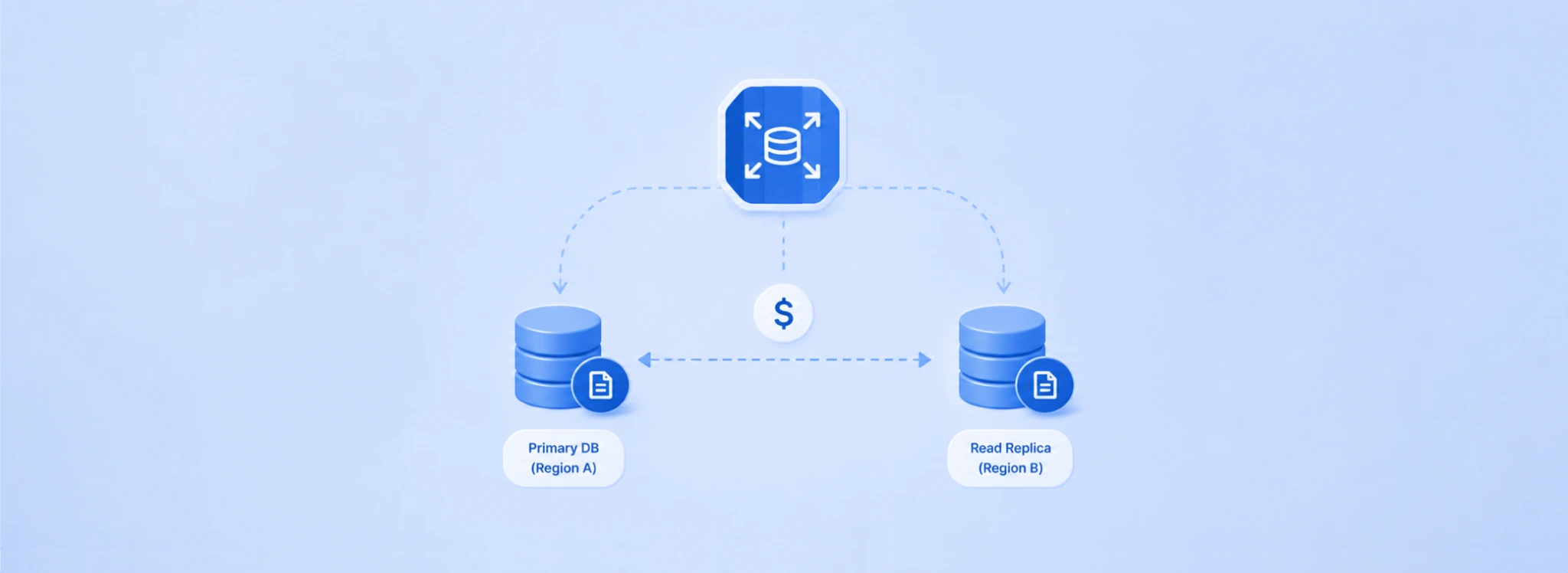
An RDS cross-region read replica is a running database instance in a different AWS region that stays synchronized with your primary database via continuous replication. It serves read traffic for geographically distributed users, provides a fast disaster recovery target in a separate region, and enables database migrations to new regions without downtime. Every cross-region read replica costs what any comparable RDS instance costs in the destination region, plus a data transfer charge of $0.02 per GB for the replication traffic crossing the regional boundary.
For a write-heavy production database transferring 100 GB of changes per day, the annual data transfer cost is $730. For a mostly-read database transferring 1 GB of changes per day, the annual data transfer cost is $7.30. The instance compute cost dominates in both cases. A db.r8g.xlarge in EU West running as a cross-region replica costs $350/month in compute regardless of how much data flows through it. Understanding this asymmetry helps you make better decisions about when a cross-region read replica is worth the cost and when a simpler single-region architecture with periodic snapshots serves the same purpose.
What Does an RDS Cross-Region Read Replica Cost in Total?
The total monthly cost of an RDS cross-region read replica has four components. Here is each component with April 2026 rates (verify at aws.amazon.com/rds/pricing — rates change).
| Cost Component | Rate | Free Tier | Example: 1 GB/day replication | Example: 100 GB/day replication |
| Replica compute (instance-hours) | Same as primary in destination region | None | db.r8g.xlarge MySQL EU West: $350/month | $350/month (unaffected by replication volume) |
| Cross-region data transfer (replication) | $0.02/GB out from source region | None | 1 GB x 30 days x $0.02 = $0.60/month | 100 GB x 30 days x $0.02 = $60/month |
| Replica storage (gp3) | $0.115/GB-month in destination region | None | 500 GB: $57.50/month | 500 GB: $57.50/month |
| Replica backup storage (automated) | Free up to 100% of replica storage | 100% of replica storage | $0 if within free tier | $0 if within free tier |
| KMS key for encryption (if encrypted) | $1/key/month + $0.03/10K API calls | None | $1/month per KMS key | $1/month per KMS key |
| Same-region replication (for comparison) | $0.00 (free) | Always free | $0 | $0 |
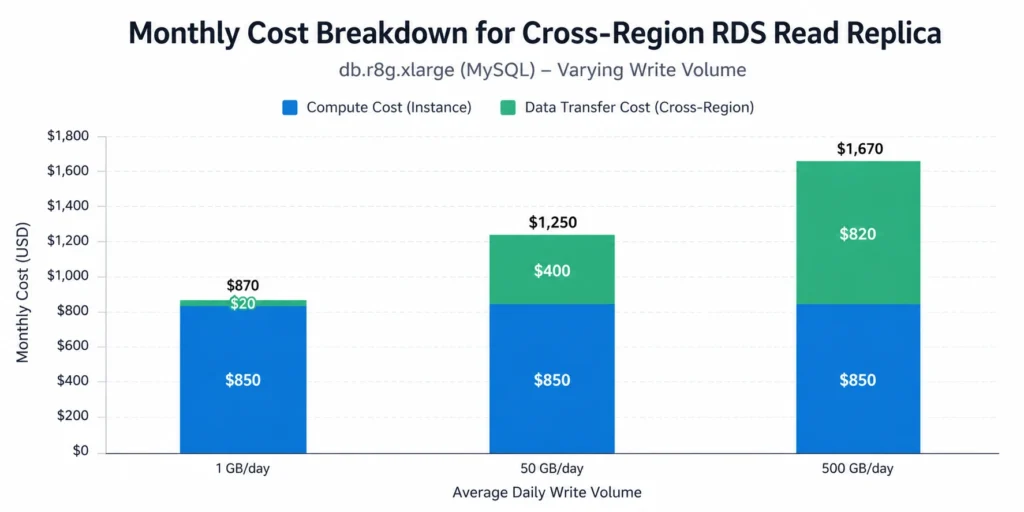
The compute cost dominates at almost every scale. The data transfer charge ($0.02/GB) only becomes a significant percentage of total cost at extreme write volumes. At 100 GB/day, data transfer is 13% of total cost. At 10 GB/day, it is 1.5%. At 1 GB/day, it is 0.15%. If your cross-region replica cost optimization strategy focuses primarily on data transfer, you are optimizing the wrong line item.
Also read: RDS Reserved Instances: 1-Year vs 3-Year Break-Even Across All Engines
What Is the Data Transfer Cost for Cross-Region Replication at Different Write Volumes?
Here is the annual data transfer cost for RDS cross-region read replicas at six write volumes, for the most common regional pairings (verify at aws.amazon.com/ec2/pricing/on-demand/#Data_Transfer — rates change).
| Daily Write Volume | Monthly GB Transferred | Monthly Transfer Cost | Annual Transfer Cost | % of $350/month compute | Cost Tier |
| 100 MB/day | 3 GB | $0.06 | $0.72 | 0.02% | Negligible |
| 1 GB/day | 30 GB | $0.60 | $7.20 | 0.17% | Negligible |
| 10 GB/day | 300 GB | $6.00 | $72.00 | 1.7% | Minor |
| 50 GB/day | 1,500 GB | $30.00 | $360.00 | 8.6% | Moderate |
| 100 GB/day | 3,000 GB | $60.00 | $720.00 | 17% | Significant |
| 500 GB/day | 15,000 GB | $300.00 | $3,600.00 | 86% | Material cost driver |
The implication for cost strategy: for write volumes under 100 GB/day, the cross-region data transfer cost is a secondary concern. Optimize the compute cost first, using reserved instances (29-69% savings) and right-sizing. Only for high-write-volume databases (500+ GB/day) does the data transfer cost become a primary optimization target worth restructuring the architecture to reduce.
Which RDS Engines Support Cross-Region Read Replicas?
Engine support for cross-region read replicas is not universal. This is one of the most important limitations to understand before committing to a cross-region architecture.
| Engine | Cross-Region Replica Supported | Notes | Version Requirements | Encryption Notes |
| MySQL | Yes | Logical replication via binlog | 5.7 and higher | Custom KMS key required for encrypted replicas |
| MariaDB | Yes | Same as MySQL binlog replication | 10.4 and higher | Custom KMS key required |
| PostgreSQL | Yes | Logical replication (pglogical-based) | 9.6 and higher for cross-region | Custom KMS key required |
| Oracle | Yes (with limitations) | Supported but check specific edition/version | Verify at AWS docs for your edition | Custom KMS key required |
| SQL Server Express Edition | Yes (very limited) | 10 GB max database size, limited features | 2012 SP2 and later, Express only | Custom KMS key required |
| SQL Server Standard / Enterprise | NOT supported | Cross-region replicas not available for SE or EE | N/A | N/A — not applicable |
| Aurora MySQL | Via Aurora Global Database (different mechanism) | Use Aurora Global Database, not standard RDS replica | MySQL-compatible Aurora 3+ | Standard Aurora encryption |
The SQL Server Standard and Enterprise limitation is the most practically impactful. Many enterprise teams running SQL Server on RDS assume cross-region replicas work for all SQL Server editions, then discover at architecture review that they need a different DR approach.
What Are the Three Use Cases for RDS Cross-Region Read Replicas?
Before modeling the cost, it is worth being explicit about what cross-region read replicas actually solve. There are three legitimate use cases, each with a different cost-benefit calculus.
Use Case 1: Disaster Recovery with Low RTO
A cross-region read replica can be promoted to a standalone primary instance in a matter of minutes if the source region becomes unavailable. The RTO (recovery time objective) is the time to promote the replica and update application connection strings: typically 5-15 minutes for a well-prepared DR procedure. The RPO (recovery point objective) is approximately the replication lag: normally 1-5 seconds for cross-region replication, meaning you might lose under 5 seconds of writes in the worst case.
Cost-benefit for DR: the monthly cost of the cross-region replica is the insurance premium for this recovery capability. For a db.r8g.xlarge MySQL with 10 GB/day write volume, the monthly premium is $350 + $6 + $57.50 = $413.50/month. Compare this to the business cost of an hour of downtime if the primary region fails. For most production SaaS applications, one hour of downtime costs $10,000-500,000+ in lost revenue, customer credits, and reputational damage. The cross-region replica premium is justified for any production workload where region-level failure is a non-negligible risk.
Use Case 2: Low-Latency Reads for Distributed Users
If your primary database is in US East (N. Virginia) and you have a significant user base in Europe, a cross-region read replica in EU West (Ireland) reduces read latency for European users from 80-120 ms (transatlantic) to 5-20 ms (local). For read-heavy applications where query latency directly affects user experience, this architectural choice improves product quality.
Cost-benefit for latency: the cross-region replica adds a full instance cost in the destination region. If 30% of your read traffic comes from Europe, you are paying $413/month to serve 30% of your reads at lower latency. Evaluate whether a caching layer (ElastiCache in the EU region) or a CDN for cacheable content achieves the same latency improvement at lower cost before committing to a full cross-region replica.
Use Case 3: Cross-Region Migration
When migrating a database from one region to another (e.g., US East to EU Central for data residency requirements), a cross-region read replica provides the lowest-downtime migration path. Create the replica, let it sync fully, promote it during a short maintenance window, and update connection strings. The migration data transfer cost is a one-time charge: approximately $0.02/GB x database size for the initial sync.
Cost-benefit for migration: the replication cost during migration is proportional to database size and runs from hours (small database) to days (large database). A 1 TB database migration generates approximately $20 in initial sync data transfer plus $350-700/month in replica compute during the sync period. After migration, the old primary can be terminated, and you save the primary region compute cost.
Also read: RDS Reserved Instances: Engine-by-Engine Pricing and Commitment Guide
How Do You Apply Reserved Instances to RDS Cross-Region Read Replicas?
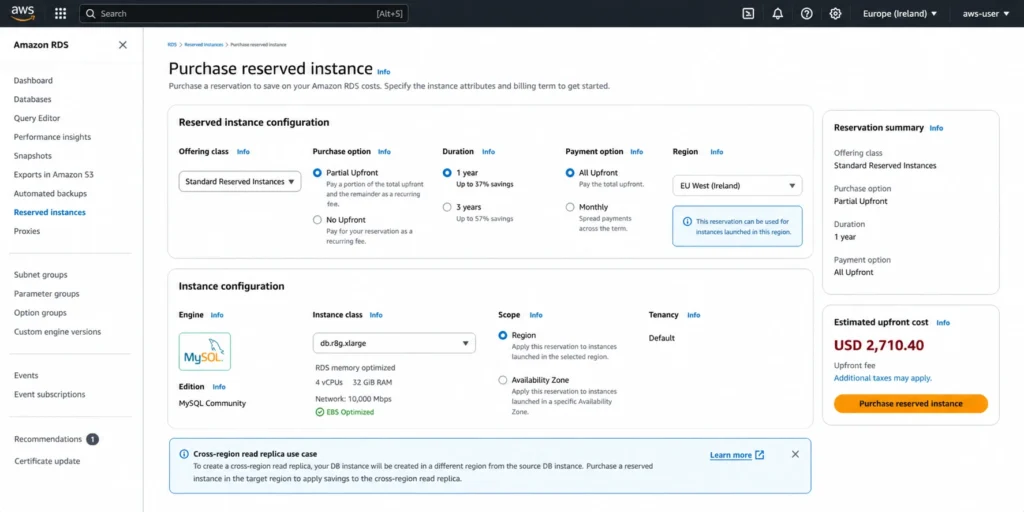
Cross-region read replicas are standard RDS instances in the destination region. They are billed exactly like any other RDS instance. Reserved instances in the destination region apply to cross-region replicas using the same engine, instance family, and deployment type matching rules as any other reservation.
To cover a cross-region replica with a reserved instance: purchase a reserved instance in the destination region (not the source region) for the engine, instance family, and Single-AZ or Multi-AZ type that matches your replica. AWS automatically applies the discount to the matching running instance in that region.
Cross-region read replicas are Single-AZ by default. They are a single instance in the destination region with no built-in high availability. If you want Multi-AZ coverage in the destination region for your DR setup, you need to either convert the promoted instance to Multi-AZ after promotion or run a second same-region replica as a standby alongside the cross-region replica. Plan your reserved instance purchases accordingly.
Reserved instance savings on a cross-region replica are identical to any other RDS instance: 29-34% on a 1-year No Upfront, up to 55-66% on a 3-year All Upfront depending on the engine. For a db.r8g.xlarge MySQL cross-region replica at $350/month on-demand, a 3-year All Upfront reservation saves approximately $192/month, $2,304/year, $6,912 over the 3-year term. For teams running permanent cross-region replicas for DR purposes, the reservation is clearly justified.
What Are the Technical Requirements for RDS Cross-Region Read Replicas?
Encryption Requirements
If your source RDS instance is encrypted, the cross-region replica must also be encrypted. The cross-region replica cannot use the same KMS key as the source because KMS keys are regional. You must use a customer-managed KMS key (CMK) in the destination region. The default RDS-managed KMS key cannot be used for cross-region replicas. If your source instance is not encrypted, the cross-region replica can be either encrypted or unencrypted.
KMS CMK cost: $1/key/month plus $0.03 per 10,000 API calls. For a typical cross-region replica, the KMS cost is $1-2/month, which is immaterial relative to compute costs. The operational complexity of managing separate CMKs in multiple regions is the more significant concern than the dollar cost.
VPC and Networking Requirements
The replica is created in a VPC in the destination region. You need a DB subnet group configured in the destination region before creating the replica. Security groups in the destination region must allow the database traffic from your application in that region. The replica does not need a direct network connection to the source region for application traffic: your application connects to the replica using the replica’s local endpoint. Only the replication traffic between AWS regions uses the AWS global backbone.
Parameter Group and Option Group
The cross-region replica uses the default parameter group for the engine version in the destination region unless you specify a custom parameter group. If your source instance uses custom parameter groups that affect replication behavior (e.g., binlog_format for MySQL), ensure the destination region parameter group has compatible settings. Option groups are region-specific and must be recreated in the destination region if you use custom options.
Automated Backups on the Replica
By default, cross-region read replicas do not have automated backups enabled. You can enable automated backups on the replica independently from the source instance. If the replica is being used for DR purposes, enabling backups provides an additional recovery point within the destination region. Backup storage costs in the destination region are separate from the source region backup quota.
What Is the Replication Lag and How Does It Affect Cost?
Cross-region replication lag is the delay between a write on the primary and its appearance on the replica. Under normal conditions, expect 1-5 seconds of lag for cross-region RDS replicas. Lag increases during periods of high write throughput or when the replica falls behind due to compute constraints.
Replication lag directly affects RPO: if you promote a replica with 10 seconds of lag, you may lose up to 10 seconds of writes from the primary. For most applications, 1-5 seconds of potential data loss is acceptable for a disaster recovery scenario. For financial or transactional applications requiring zero data loss (RPO = 0), a cross-region read replica is not sufficient. Consider Aurora Global Database with the GLOBAL_WRITE_FORWARDING feature or a synchronous cross-region replication approach.
Monitoring replication lag: CloudWatch provides the ReplicaLag metric for RDS read replicas. Set an alarm when ReplicaLag exceeds your RPO threshold (e.g., 10 seconds). If lag consistently exceeds 30 seconds, the replica instance may be undersized relative to the source’s write volume, or network congestion between regions is affecting throughput.
Impact on cost: high replication lag may indicate you need a larger instance class for the replica to keep up with the write throughput. Upsizing from db.r8g.xlarge to db.r8g.2xlarge doubles the compute cost from $350 to $700/month. Right-size the replica instance to keep lag below your RPO threshold without over-provisioning.
How Does an RDS Cross-Region Read Replica Cost Compare to Alternative DR Approaches?
A cross-region read replica is one of several DR approaches for RDS. Here is how the cost and recovery capability compare.
Option 1: Cross-Region Read Replica (Continuous Replication)
Monthly cost: full on-demand instance rate in destination region + $0.02/GB replication transfer + storage. Recovery capability: RPO of 1-5 seconds, RTO of 5-15 minutes (promotion + connection string update). Best for: production databases with sub-minute RPO requirements and willingness to pay for a permanent running replica. Annual cost for db.r8g.xlarge MySQL, 10 GB/day writes: ($350 compute + $6 transfer + $57.50 storage) x 12 = $4,962/year.
Option 2: Cross-Region Automated Backup Copies
Monthly cost: $0.02/GB for the snapshot transfer at creation + $0.095/GB-month excess backup storage in destination region (if above free tier). Recovery capability: RPO equal to the last backup (up to 24 hours), RTO of 30-60 minutes (snapshot restore time). Best for: databases where 24-hour RPO is acceptable and no budget for a permanent running replica. Annual cost for 500 GB database, daily backup copies: ($0.02 x 500 x 365) + (500 x $0.095) = $3,650 transfer + $570 storage = $4,220/year. Cheaper than a replica but with much worse RPO.
Option 3: Same-Region Multi-AZ plus Periodic Snapshots
Monthly cost: 2x compute for Multi-AZ (synchronous standby in same region) plus $0.095/GB-month for any excess backup storage if you take manual snapshots. No cross-region protection. Recovery capability: RPO of 0 (synchronous replication), RTO of 60-120 seconds (automatic Multi-AZ failover within region). No cross-region DR capability. Best for: protecting against single instance failure or single AZ failure without cross-region requirements. This option does not protect against region-level failure.
Option 4: Periodic Manual Snapshots with Cross-Region Copy
Monthly cost: $0.02/GB per snapshot copy transfer + $0.023/GB-month S3 storage in destination region. Recovery capability: RPO equal to snapshot frequency (daily or weekly), RTO of 60-120 minutes (restore from snapshot). Best for: compliance-driven backup retention in a second region where actual DR failover is rarely exercised. Annual cost for weekly 500 GB snapshot copies: ($0.02 x 500 x 52 copies) = $520 transfer + nominal S3 storage = approximately $600/year. Dramatically cheaper than a replica but with RPO measured in days.
The cross-region read replica is the most expensive option and provides the best RPO/RTO. The decision is whether your application’s business requirements justify the permanent cost of a running replica versus the alternative approaches that trade recovery time for lower cost.
Also read: AWS Database Savings Plans Explained for DB Teams
How Do You Promote an RDS Cross-Region Read Replica and What Happens to Costs?
Promoting a cross-region read replica to a standalone primary instance is the DR failover step. The promotion process breaks replication, converts the replica to an independent primary, and makes it writable. Here is what happens to billing during and after promotion.
Before Promotion
You are paying for the source primary instance in the original region and the cross-region replica in the destination region. Replication data transfer ($0.02/GB) continues until promotion. The replica is billed as a Single-AZ instance in the destination region.
During Promotion
Promotion typically completes in a few minutes and does not add any cost. The instance remains running and billed during the promotion process. After promotion, replication from the source ceases. The data transfer charge stops. The promoted instance becomes writable and operates as a standalone primary.
After Promotion
The promoted instance is now a standard RDS primary instance in the destination region. It retains its instance class, storage, and parameter group configuration. Automated backups are automatically enabled with the default 1-day retention period if they were not already configured on the replica. The instance is billed as any standard RDS instance at on-demand rates in the destination region.
Reserved instance coverage after promotion: if you had a reserved instance in the destination region matching the replica’s configuration, it continues applying to the promoted instance. If you did not have a reservation and are now using this as your permanent primary, purchase a reserved instance immediately to capture savings going forward. Usage.ai Flex Reserved Instances automatically detect the promotion event and recommend the appropriate reservation for the newly promoted primary.
What Happens to the Original Primary
After a DR failover and promotion, your original primary in the source region continues running and billing unless you stop or terminate it. If the original region has recovered, you face a choice: recreate replication from the new primary back to the old region (making the new primary the source and the old region the replica), or terminate the old primary to stop billing. Do not leave the old primary running indefinitely without a plan — it continues accumulating on-demand charges.
How Does Usage.ai Optimize Cross-Region Read Replica Costs?
Cross-region read replicas are standard RDS instances in the destination region and are fully eligible for the same reserved instance optimization that Usage.ai applies to any RDS instance. Teams often purchase reserved instances for their primary databases but overlook the replicas, leaving full on-demand rates on instances that may run for years as permanent DR infrastructure.
Usage.ai Flex Reserved Instances monitors all RDS instances in all active regions, including cross-region read replicas. The platform identifies replicas that have run continuously for 30+ days as permanent DR or read-scaling infrastructure and recommends reserved instance purchases in the destination region.
Analysis refreshes every 24 hours versus AWS Cost Explorer’s 72+ hour cycle, ensuring replicas that were recently created are evaluated quickly. If a replica is promoted and the reserved instance no longer matches the new production configuration, Usage.ai identifies the gap and purchases the appropriate reservation. The fee is a percentage of realized savings only.
See how much you can save on RDS read replicas with Usage.ai
Frequently Asked Questions
1. What is an RDS cross-region read replica?
An RDS cross-region read replica is a copy of your primary RDS database running in a different AWS region. It stays synchronized with the primary via continuous replication, serves read queries in the destination region, and can be promoted to a standalone primary for disaster recovery. It costs the same per-hour rate as any standard RDS instance in the destination region plus $0.02/GB for the replication data transfer.
2. What is the data transfer cost for cross-region RDS replication?
AWS charges $0.02 per GB transferred from the source region to the destination region for RDS cross-region read replica replication. Same-region replication (read replicas in the same region) is free. For a database with 10 GB of daily writes, the monthly cross-region transfer cost is $6.00 ($72/year). The instance compute cost typically exceeds the data transfer cost by 10-100x at normal write volumes.
3. Does SQL Server support cross-region read replicas on RDS?
SQL Server Standard and Enterprise editions do NOT support cross-region read replicas on Amazon RDS. Only SQL Server Express Edition supports cross-region replicas, and Express Edition has a 10 GB maximum database size limit. Teams running SQL Server SE or EE who need cross-region DR must use RDS automated snapshot copies to the destination region or explore AWS DMS for ongoing replication. This is a significant architectural constraint.
4. Can you use reserved instances for cross-region read replicas?
Yes. Cross-region read replicas are standard RDS instances in the destination region and are fully eligible for reserved instance discounts. Purchase a reserved instance in the destination region (not the source) matching the replica engine, instance family, and deployment type. The same 29-69% savings available for primary instances apply to replicas.
5. What is the replication lag for RDS cross-region read replicas?
Under normal conditions, replication lag for RDS cross-region read replicas is 1-5 seconds. Lag increases during high write throughput or network congestion. Monitor the ReplicaLag CloudWatch metric. Set alarms when lag exceeds your RPO threshold. Persistent lag above 30 seconds may indicate the replica instance is undersized relative to the write volume of the primary.
6. What happens to a cross-region read replica when the primary is deleted?
When you delete the source RDS instance, cross-region read replicas are automatically promoted to standalone instances. They stop replicating from the source and become independent databases in the destination region. Automated backups are enabled automatically. You begin paying full on-demand instance rates in the destination region without any replication data transfer charges.
7. Do you need a custom KMS key for cross-region replicas?
Yes, if your source instance is encrypted. The default RDS-managed KMS key cannot be used for cross-region replication because KMS keys are regional. You must create a customer-managed KMS key (CMK) in the destination region before creating the encrypted cross-region replica. CMK cost: $1/key/month plus $0.03 per 10,000 API calls.
8. How does cross-region read replica cost compare to Aurora Global Database?
Aurora Global Database uses Aurora’s dedicated replication layer with sub-second cross-region lag versus 1-5 seconds for standard RDS cross-region replicas. Aurora Global Database charges approximately $0.20/million replication writes on top of standard Aurora instance costs. For high write volume databases requiring sub-second RPO, Aurora Global Database provides better replication latency. For standard DR with 1-5 second RPO requirements, RDS cross-region replicas on open-source engines are typically cheaper.