.png)


Choose DynamoDB Standard-IA when your table stores large volumes of data that is rarely accessed, and storage costs make up more than 50% of your total DynamoDB table cost.
Choose Standard class for everything else, especially tables with active read/write traffic where throughput dominates the bill. If your Standard table qualifies for reserved capacity (provisioned mode, stable utilization above 70%), the reserved discount may beat Standard-IA even for storage-heavy tables. Both classes deliver identical performance, durability, and availability.
How Does DynamoDB Standard vs Standard-IA Pricing Compare Side by Side?
Here is the complete DynamoDB table class cost comparison for US East (N. Virginia) as of April 2026.
| Dimension | Standard | Standard-IA | Difference | IA Savings/Cost | Notes |
| Storage | $0.25/GB-month | $0.10/GB-month | -$0.15/GB | 60% cheaper | First 25 GB free on Standard only |
| On-Demand Write (WRU) | $1.25/M | $1.5625/M | +$0.3125/M | 25% more expensive | Per million write request units |
| On-Demand Read (RRU) | $0.25/M | $0.3125/M | +$0.0625/M | 25% more expensive | Per million read request units |
| Provisioned Write (WCU) | $0.00065/WCU-hr | $0.00081/WCU-hr | +$0.00016 | ~25% more expensive | Per WCU per hour |
| Provisioned Read (RCU) | $0.00013/RCU-hr | $0.00016/RCU-hr | +$0.00003 | ~23% more expensive | Per RCU per hour |
| Reserved Capacity | Available (53-77% savings) | NOT available | N/A | Standard-only benefit | Significant for provisioned tables |
| Free Tier Storage | 25 GB/month | None | N/A | Standard-only benefit | Always Free, no expiration |
| Performance | Identical | Identical | None | No difference | Same latency, durability, SLA |
What Is the Exact Crossover Point for DynamoDB Standard vs Standard-IA?
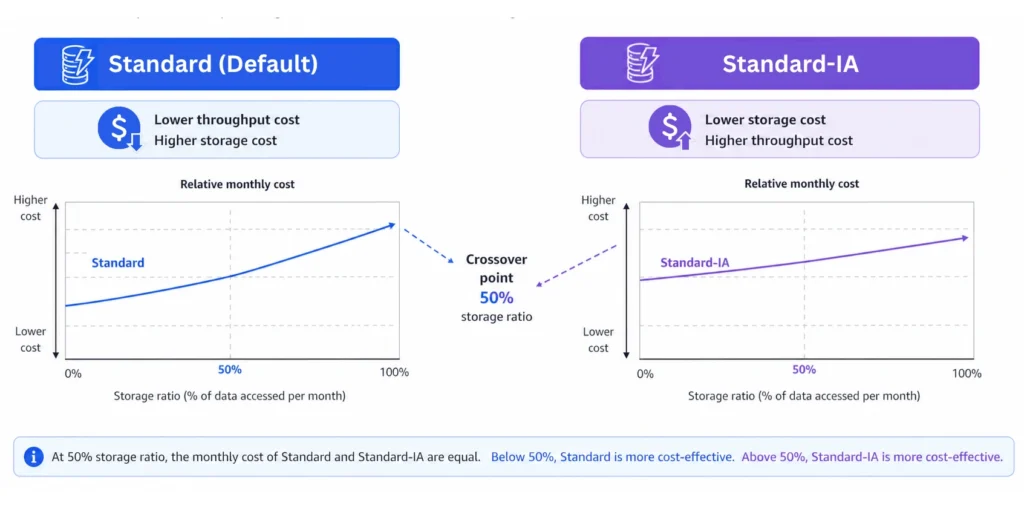
AWS recommends switching to DynamoDB Standard-IA when storage costs exceed 50% of your total table cost (storage + throughput). Here is the math behind that threshold.
For a table costing $100/month total on Standard class: if storage is $55 and throughput is $45, switching to Standard-IA reduces storage from $55 to $22 (60% savings = $33 saved) but increases throughput from $45 to $56.25 (25% increase = $11.25 added). Net savings: $33.00 – $11.25 = $21.75/month (21.75% total reduction).
At the 50% crossover: storage is $50 and throughput is $50. Standard-IA saves $30 on storage but adds $12.50 on throughput. Net savings: $17.50/month (17.5% total reduction). Still beneficial.
Below 30% storage ratio: storage is $30 and throughput is $70. Standard-IA saves $18 on storage but adds $17.50 on throughput. Net savings: $0.50/month. Effectively break-even. Below 30% storage ratio, the switch is not worth the operational overhead.
Also read: DynamoDB Reserved Capacity: 1-Year vs 3-Year Pricing Compared
How Does a DynamoDB Standard-IA Table Compare at Different Storage Sizes?
Here is the DynamoDB table class cost comparison across four realistic workload profiles, all using on-demand capacity in US East.
| Workload Profile | Standard Total | Standard-IA Total | Net Savings | Verdict |
| 50 GB, 50M reads, 10M writes (storage = 18%) | $137.75 | $120.63 | $17.12 (12%) | Marginal: either works |
| 500 GB, 10M reads, 2M writes (storage = 79%) | $160.00 | $68.44 | $91.56 (57%) | Strong IA win |
| 1 TB, 42.5M reads, 42.5M writes (storage = 45%) | $369.56 | $246.30 | $123.26 (33%) | Clear IA win |
| 10 GB, 100M reads, 50M writes (storage = 3%) | $90.00 | $110.63 | -$20.63 (+23%) | Standard wins: IA costs more |
The pattern is clear: DynamoDB Standard-IA saves money when storage is the dominant cost component. For the 500 GB low-traffic table, Standard-IA saves $91.56/month ($1,099/year). For the high-traffic, low-storage table, Standard-IA actually costs $20.63 more per month because the throughput increase outweighs the storage savings.
Why Can Reserved Capacity on Standard Beat Standard-IA for Some Tables?
This is the comparison gap that no competitor addresses. DynamoDB reserved capacity provides 53% (1-year) to 77% (3-year) savings on provisioned throughput, but reserved capacity is only available for the Standard table class. Standard-IA tables cannot use reserved capacity at all.
For a provisioned table where throughput costs are significant, the reserved capacity discount on Standard class can produce a lower total cost than Standard-IA, even when storage is a large percentage of the bill.
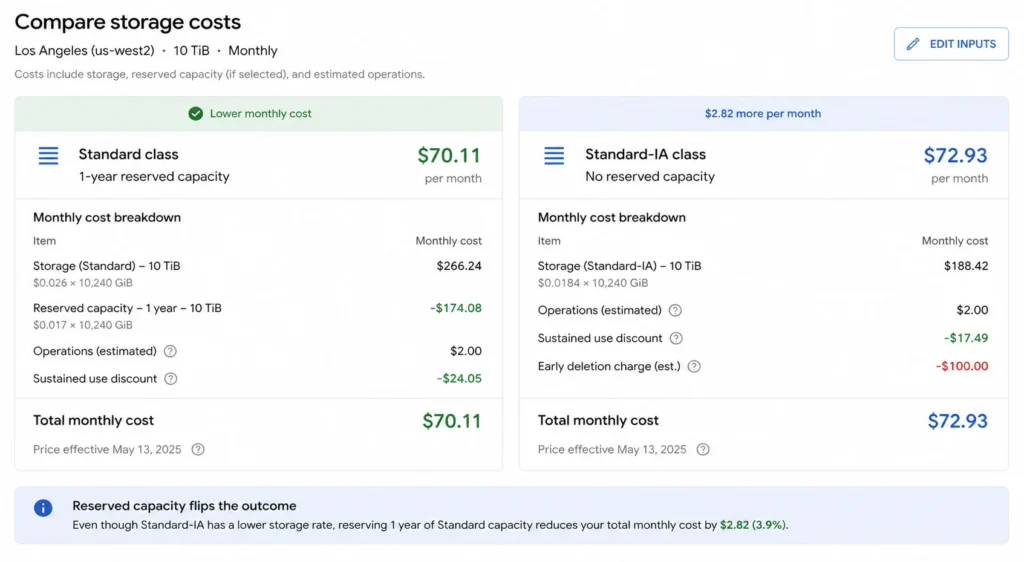
Worked example: A table with 200 GB storage and 200 provisioned RCU + 50 provisioned WCU. Standard class (with 1-year reserved capacity): Storage: 200 GB x $0.25 = $50.00/month. Throughput (reserved, ~54% off): (200 RCU x $0.0000612/hr + 50 WCU x $0.000306/hr) x 730 = $8.94 + $11.17 = $20.11/month. Total: $70.11/month.
Standard-IA class (no reserved capacity available): Storage: 200 GB x $0.10 = $20.00/month. Throughput (standard IA rates): (200 RCU x $0.00016/hr + 50 WCU x $0.00081/hr) x 730 = $23.36 + $29.57 = $52.93/month. Total: $72.93/month.
Standard with reserved capacity ($70.11) is $2.82/month cheaper than Standard-IA ($72.93) for this workload, despite Standard’s higher storage rate. The reserved capacity discount on throughput more than offsets the storage premium. This scenario applies to provisioned tables with moderate storage and consistent throughput, the exact workload profile where Usage.ai Flex Reserved Instances deliver the most value.
Also read: DynamoDB Auto Scaling for Provisioned Capacity
What Are the Restrictions on Switching DynamoDB Table Classes?
DynamoDB allows switching between Standard and Standard-IA with no downtime or code changes, but with several constraints:
Switch limit: You can change a table’s class up to 2 times in any rolling 30-day period. This prevents rapid back-and-forth switching but allows testing and reverting.
GSI inheritance: All Global Secondary Indexes and Local Secondary Indexes automatically adopt the same class as the base table. You cannot have a Standard base table with Standard-IA GSIs or vice versa. This means the throughput cost increase applies to all GSI reads and writes, not just the base table.
Free tier: The 25 GB/month Always Free storage tier applies only to Standard class tables. Switching to Standard-IA forfeits this benefit. For tables under 25 GB, Standard class with the free tier is almost always cheaper.
Reserved capacity: Not available for Standard-IA. If you currently have reserved capacity applied to a Standard table and switch to Standard-IA, the reserved capacity continues to be charged but no longer applies to the table’s throughput. The reserved capacity becomes stranded.
Global Tables: Both table classes work with Global Tables. Each replica can use either class independently. You can have a Standard primary with a Standard-IA DR replica.
How Should You Identify DynamoDB Standard-IA Candidates in Your Account?
Method 1: AWS Cost Explorer
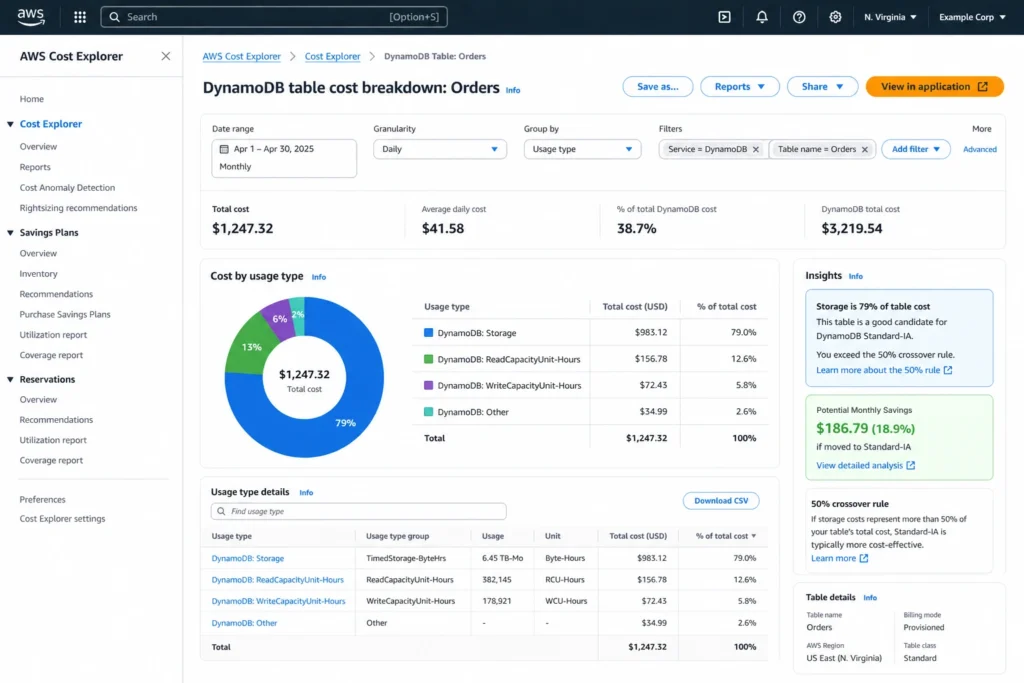
Navigate to Cost Explorer, filter by Service = Amazon DynamoDB, group by Usage Type. Compare the storage line items (TimedStorage-ByteHrs) against throughput line items (WriteCapacityUnit-Hrs, ReadCapacityUnit-Hrs, or PayPerRequestThroughput). If storage exceeds 50% of total DynamoDB cost for a specific table, it is a candidate for DynamoDB Standard-IA.
Method 2: CloudWatch Metrics
Pull the AccountProvisionedReadCapacityUtilization and AccountProvisionedWriteCapacityUtilization metrics alongside the TableSizeBytes metric for each table. Tables with low utilization (under 30%) and large storage (over 100 GB) are strong DynamoDB Standard-IA candidates.
Method 3: Cost and Usage Report Query
If you have CUR data in Athena, query for DynamoDB tables where storage cost exceeds 50% of total table cost over the past 30 days. CloudFix published a useful SQL query for this analysis (referenced in their DynamoDB Standard-IA guide). Group by line_item_resource_id and sum storage versus throughput cost types.
How Does Usage.ai Help Optimize DynamoDB Table Class Decisions?
The Standard vs Standard-IA decision is one dimension of DynamoDB storage cost optimisation. The larger cost optimisation comes from the capacity management layer: choosing between on-demand and provisioned, right-sizing provisioned capacity, and purchasing reserved capacity for Standard class tables.
Usage.ai Flex Reserved Instances continuously analyze your DynamoDB tables, including tables that are borderline Standard-IA candidates. For tables where reserved capacity on the Standard class produces a lower total cost than Standard-IA (as shown in the worked example above), Usage.ai automatically purchases the reserved capacity that makes the Standard class cheaper.
The platform refreshes its analysis every 24 hours, compared to AWS Cost Explorer’s 72+ hour cycle. If a reservation becomes underutilised, Usage.ai provides cashback and credits on the unused portion. The fee is a percentage of realized savings only.
See how much you can save on DynamoDB with Usage.ai
Choose Standard When… Choose Standard-IA When…
Choose DynamoDB Standard When:
Throughput (reads + writes) represents more than 50% of your total table cost. Your table stores less than 25 GB (free tier covers Standard storage). You use or plan to use reserved capacity for provisioned throughput. Your table has high read/write frequency with moderate storage. You want the deepest possible per-request cost with reserved capacity stacking.
Choose DynamoDB Standard-IA When:
Storage represents more than 50% of your total table cost. Your table stores over 100 GB of infrequently accessed data (logs, order history, audit trails, archived records). You use on-demand capacity mode (where reserved capacity is not an option anyway). Your table’s read/write traffic is low and sporadic. You want the simplest path to DynamoDB storage cost optimization without commitment-based discounts.
Frequently Asked Questions
1. What is DynamoDB Standard-Infrequent Access?
DynamoDB Standard-IA is an alternative table class that reduces storage costs by 60% ($0.10/GB vs $0.25/GB) while increasing read and write throughput costs by approximately 25%. It provides identical performance, durability, and availability to the Standard class. Best suited for tables where storage is the dominant cost and access frequency is low.
2. How much does DynamoDB storage cost per GB?
DynamoDB Standard class charges $0.25 per GB-month in US East (N. Virginia). DynamoDB Standard-IA charges $0.10 per GB-month, a 60% reduction. The first 25 GB per month is free on Standard class tables only. Storage pricing is the same for both on-demand and provisioned capacity modes.
3. Can you switch DynamoDB table classes without downtime?
Yes. Switching between Standard and Standard-IA causes no downtime, requires no code changes, and takes effect immediately. All GSIs inherit the new table class automatically. You can switch up to 2 times in any rolling 30-day period. The switch can be done via the AWS console, CLI, or SDK.
4. Does DynamoDB Standard-IA support reserved capacity?
No. Reserved capacity (53-77% provisioned throughput discount) is available only for the DynamoDB Standard table class. Standard-IA tables must pay the full Standard-IA provisioned or on-demand throughput rates. This is a significant limitation for provisioned tables with stable traffic.
5. When should you NOT switch to DynamoDB Standard-IA?
Do not switch when throughput cost exceeds 70% of total table cost, when the table stores under 25 GB (Standard free tier is more valuable), when you use reserved capacity on the Standard class (switching strands the reservation), or when the table is read/write-heavy with small storage. In these cases, Standard class with reserved capacity is cheaper.
6. Is DynamoDB Standard-IA cheaper for small tables?
Rarely. Tables under 25 GB benefit from the Standard class free tier (25 GB/month free storage). A 20 GB table on Standard pays $0.00 for storage. The same table on Standard-IA pays $2.00/month for storage and loses the free tier. Standard-IA only makes financial sense for tables well above 25 GB with low access frequency.
7. What is cheaper, DynamoDB or RDS?
It depends on workload characteristics. DynamoDB is cheaper for key-value lookups at scale with sub-millisecond latency. RDS is typically cheaper for complex relational queries on datasets under 1 TB. DynamoDB scales horizontally with no instance management. RDS requires instance sizing and can be cheaper with Reserved Instances for steady relational workloads.
8. Does switching to Standard-IA affect DynamoDB Streams?
No. DynamoDB Streams functionality and pricing are identical for both table classes. Streams read request units cost $0.02 per 100,000 reads regardless of table class. The table class switch does not interrupt active streams or Lambda triggers connected to the stream.