.png)



Key Takeaways
|
If you’re evaluating commitment automation platforms, understanding the differences between solutions is critical. Both ProsperOps and Usage.ai automate commitment purchasing across AWS, GCP, and Azure. The differences that matter: speed to full coverage, recommendation refresh frequency, and financial protection when usage drops.
This comparison explores how Usage.ai and ProsperOps stack up across the dimensions that matter most: time to ROI, recommendation accuracy, database commitment automation, and cashback vs credits protection. We detail each platform’s verified capabilities, industry-standard benchmarks, and the specific tradeoffs to help you make an informed decision for your team.
What Is ProsperOps and How Does It Work?
ProsperOps is a multi-cloud commitment automation platform that autonomously purchases and manages Savings Plans and Reserved Instances across AWS, Azure, and Google Cloud. The platform’s core metric is Effective Savings Rate (ESR), which measures discount coverage relative to on-demand spend. ProsperOps operates through cloud marketplaces (AWS Marketplace, Azure Marketplace), integrates at the billing layer, and uses algorithmic purchasing to adapt commitments to usage patterns over time.
ProsperOps announced Azure support in September 2025 and expanded to Google Cloud in 2024. The platform is positioned as fully hands-off: once connected, it makes commitment decisions without manual approval loops using a strategy they call “Adaptive Laddering”, where they build commitment coverage over time to minimize over-commitment risk.
Some operational details like recommendation refresh frequency, time to full coverage, and database commitment support aren’t extensively documented in public materials. Industry benchmarks suggest most autonomous platforms take 6–9 months to reach full coverage and reference AWS Cost Explorer’s 72-hour refresh cycle.
What Is Usage.ai and How Does It Work?
Usage.ai automates AWS, GCP, and Azure commitments through Flex Commitments, an SP/RI-equivalent structure delivering 30–50% savings without multi-year lock-in or upfront payment. The platform refreshes recommendations every 24 hours, reaches full coverage in 60 days, and operates at the billing layer only with no infrastructure changes required. Setup takes 30 minutes with read-only billing access.
Verified Products:
- Usage Flex Savings Plan (EC2, Fargate, Lambda) offers 40–60% savings
- Usage Flex DB Savings Plan (RDS, ElastiCache, DocumentDB) offers 20–35% savings
- Usage Flex Reserved Instances (RDS, ElastiCache, OpenSearch, Redshift, DynamoDB) offers 30–40% savings
- Azure VM Savings Plans offers up to 50% savings
- GCP Committed Use Discounts offers up to 50% savings
Financial Protection: Cashback on underutilized commitments. If Usage.ai purchases a commitment and your usage drops, you receive real money back and not account credits tied to the cloud provider. This is a unique platform in the industry offering cashback assurance.
Verified Customers: Motive ($2.3M annual savings), EVGo/NASDAQ: EVGO ($5.2M annual savings), Secureframe ($1.8M annual savings), Blank Street Coffee ($480K annual savings). $91M+ in total savings delivered to 300+ enterprise customers.
Usage.ai vs ProsperOps: Side-by-Side Comparison
| Dimension | Usage.ai | ProsperOps | Advantage |
| Cloud Coverage | AWS, GCP, Azure | AWS, GCP, Azure (GA Sept 2025) | Tie; both multi-cloud |
| Time to Full Coverage | 60 days | Gradual rollout (industry avg: 6–9 months) | Usage.ai offers 3–4× faster ROI |
| Recommendation Refresh | 24 hours | References AWS Cost Explorer (72+ hour baseline) | Usage.ai catches waste 3 days earlier |
| Underutilization Protection | Cashback | Industry standard: Credits only | Usage.ai offers verified financial flexibility |
| Setup Time | 30 minutes | Billing-layer integration | Usage.ai offers verified fast onboarding |
| Pricing Model | % of realized savings, $0 if no savings | % of realized savings (10–20% industry standard) | Likely tie |
| Commitment Flexibility | Can be discontinued immediately | Has locked terms | Usage AI offers no lock in |
| Database Commitments | RDS, ElastiCache, DocumentDB, OpenSearch, Redshift, DynamoDB | Varies by cloud (verify coverage) | Usage.ai’s verified comprehensive |
| Verified Customer Outcomes | $5.2M (EVGo), $2.3M (Motive), $1.8M (Secureframe), $480K (Blank Street) | Available through references | Usage.ai named with public figures |
| Infrastructure Changes Required | None; billing layer only | None; billing layer integration | Tie |
| Autopilot Mode | Available; fully autonomous or manual approval | Fully autonomous by default | Likely tie |
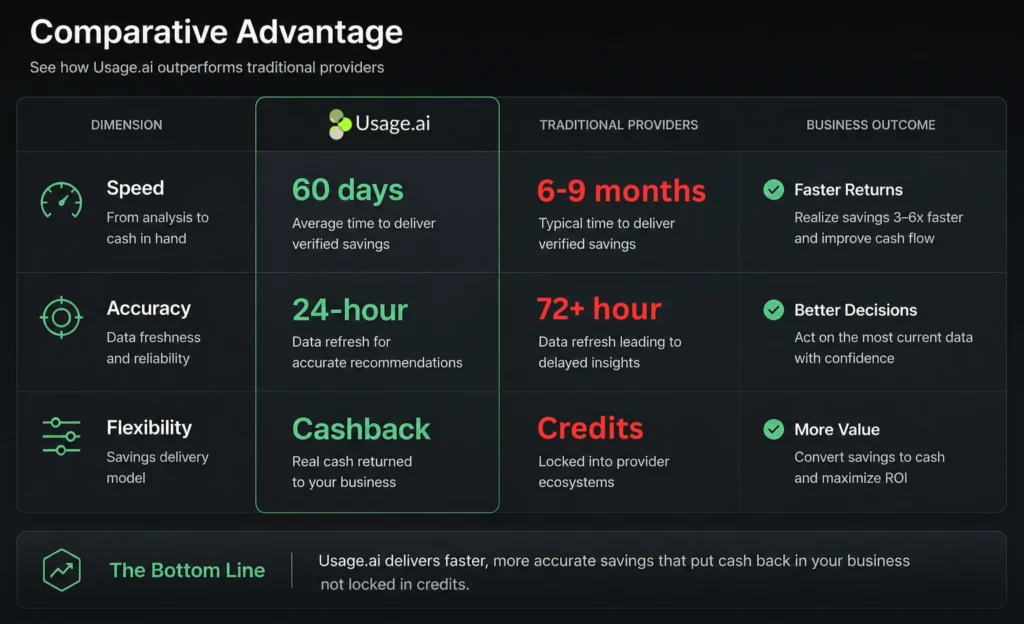
Speed to Savings: 60 Days vs 6–9 Months
Usage.ai reaches full commitment coverage in 60 days. ProsperOps follows a gradual autonomous rollout to avoid over-committing during the algorithm learning phase. Industry benchmarking shows typical timelines of 6–9 months for platforms using this conservative approach.
Why speed matters and its budget cycle impact:
Assume you’re in Q2. Your CFO allocates cloud budget in Q4 based on Q3 actuals. If your savings tool delivers full coverage by the end of Q2, your Q3 bills show the optimized baseline. Finance sees the savings, trusts the new run rate, and reduces next year’s allocation, freeing capital for hiring, product, or margin.
If your tool takes until Q4 to hit full coverage, finance sees one quarter of optimized data. They’re less confident about cutting the cloud budget, so they hold it flat or reduce conservatively.
Quantified opportunity cost:
- $500K/month AWS bill
- 40% potential savings = $200K/month recovered
- 60-day tool: $200K × 10 months = $2M first-year savings
- 6-month tool: $200K × 6 months = $1.2M first-year savings
- Opportunity cost of delay: $800K in year one
Recommendation Accuracy: 24-Hour Refresh vs Stale Data
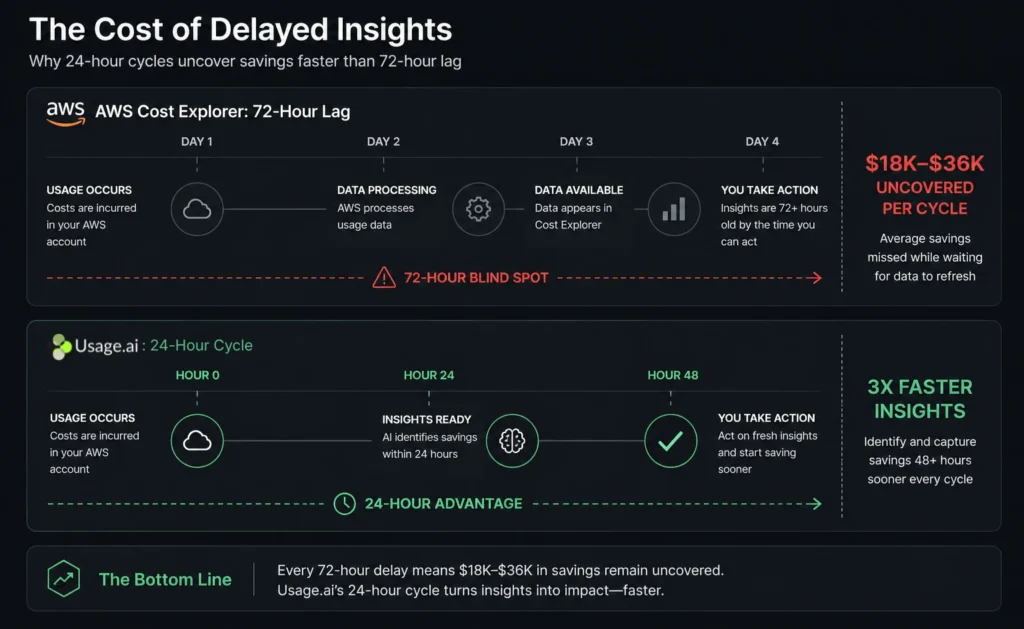
Usage.ai refreshes recommendations every 24 hours. AWS Cost Explorer (the native recommendation engine most commitment tools integrate with) refreshes every 72+ hours (documented at AWS).
Most commitment automation platforms layer algorithms on top of AWS Cost Explorer data, inheriting this 72-hour baseline unless they’ve built proprietary data pipelines. ProsperOps’ specific refresh architecture isn’t detailed in their public technical documentation.
Why refresh frequency matters in waste prevention:
Cloud usage changes daily with product launches, traffic spikes, batch job shifts create commitment gaps within hours. A tool checking every 72 hours misses three days of opportunity or waste.
Quantified impact:
- $6–12K/day in uncovered spend (typical for $2M/year AWS customer)
- 3-day lag = $18K–$36K uncovered per refresh cycle
- 52 weeks ÷ 3-day cycles = ~17 cycles per year
- Annual addressable waste from lag: $306K–$612K
Financial Protection: Cashback vs Credits
Usage.ai offers cashback on underutilized commitments. The industry-standard approach is to return underutilized value as AWS account credits. Usage.ai breaks this pattern by offering real money back.
- Cashback (Usage.ai verified): Real money returned to your bank account. Reallocate to headcount, infrastructure, product, or any line item. Fungible capital that flows through your balance sheet as recovered savings. See how cashback works.
- Credits (industry standard): Account balance with AWS. You can only spend it on AWS services. If you’re scaling down AWS, shifting to GCP/Azure, or negotiating better deals, you can’t extract value. Credits become a sunk cost.
ProsperOps’ underutilization handling isn’t extensively detailed in their public materials. Given standard industry practices and their marketplace integrations, the credits model is most common for commitment automation platforms.
When cashback matters more: Volatile usage (seasonal business, unpredictable traffic), multi-cloud strategy testing, finance team values balance sheet flexibility, M&A scenarios where cashback demonstrates cost discipline.
When credits are sufficient: AWS spend is stable and growing, zero plans to reduce AWS usage, finance comfortable with credits as recovery mechanism.
Commitment Flexibility: Discontinue Immediately vs Locked Terms
Usage.ai purchases the commitment on your behalf and assumes the financial risk if you need to exit early. You pay Usage.ai for usage while active, and discontinue when circumstances change.
ProsperOps and similar platforms purchase AWS Savings Plans or Azure Reserved Instances through your account. Those commitments are governed by AWS/Azure/GCP terms, which do not allow early cancellation. The commitment purchases are still autonomous and optimized, but the underlying cloud commitment structure remains locked.
When immediate discontinuation matters:
- M&A scenarios: Your company gets acquired and the acquirer uses a different cloud provider or has existing commitments. With Usage.ai, you can discontinue immediately with buyback protection. With standard commitments, you’re locked into paying for the full term even if you no longer need the capacity.
- Platform migrations: You’re moving workloads from AWS to GCP, or testing multi-cloud strategies. Usage.ai’s discontinuation capability means you can exit AWS commitments as you migrate without financial penalty. Standard commitments must run to term completion.
- Budget cuts: Economic downturn forces a 40% cloud spend reduction. Usage.ai lets you discontinue commitments immediately to align with new budget constraints. Traditional commitments continue billing for 1–3 years regardless of actual usage needs.
- Strategic pivots: Architecture shifts from VMs to containers, or from self-hosted databases to managed services. With Usage.ai, you can discontinue old commitments and redeploy capital. Standard commitments become sunk costs until they expire.
Why this constraint exists across the industry: AWS, Azure, and GCP offer discounts in exchange for commitment duration. The discount is the incentive for you to lock in spend. Most commitment automation platforms purchase these native instruments on your behalf, inheriting the lock-in constraint.
Usage.ai’s unique structure: Usage.ai doesn’t purchase native AWS/Azure/GCP commitments on your behalf. Usage.ai uses its Flex Commitment product, an SP/RI-equivalent that delivers the same discounts but without forcing you into multi-year cloud provider lock-in. This is why discontinuation is possible.
When discontinuation is less critical: If your cloud usage is stable and growing, if you have no M&A risk on the horizon, and if your architecture is locked in for 2–3 years, the inability to discontinue native commitments may not matter. In that scenario, any commitment automation tool delivers similar value.
Database Commitment Coverage
Usage.ai (verified):
- Flex DB Savings Plan: RDS, ElastiCache, DocumentDB (20–35% savings)
- Reserved Instances: RDS, ElastiCache, OpenSearch, Redshift, DynamoDB (30–40% savings)
- Database coverage is explicitly documented and verified across AWS services
ProsperOps: Database commitment coverage varies by cloud provider. For Azure, ProsperOps lists support for Azure SQL Database, Azure SQL Elastic Pools, Azure SQL Managed Instance, Azure Database for MySQL, and Azure Database for PostgreSQL. AWS and GCP database coverage isn’t extensively detailed in public materials. We recommend confirming RDS, ElastiCache, DocumentDB, Cloud SQL, and AlloyDB support directly if database spend is a significant portion of your bill.
Database spend is typically 20–35% of total cloud cost. Automating only compute (EC2/Fargate/Lambda) leaves a third of your bill unoptimized.
When to Choose ProsperOps
Choose ProsperOps when:
- You prefer gradual, conservative commitment rollout. If your finance team is risk-averse about commitments and wants a slower ramp-up period to observe behavior before hitting full coverage, ProsperOps’ “Adaptive Laddering” approach follows the philosophy of building commitment coverage gradually over 6–9 months to minimize over-commitment risk.
- You prioritize Effective Savings Rate (ESR) as your core metric. ProsperOps positions ESR as their primary KPI and provides benchmarking against industry peers. If your FinOps team measures success primarily through ESR, ProsperOps’ tooling is built around this metric.
- You’re comfortable with credits-based underutilization recovery. If your cloud spend is predictably growing and you’re comfortable with account credits as the recovery mechanism for underutilized commitments, this constraint doesn’t limit you.
- You’ve already validated ProsperOps’ database coverage for your workloads. If you’ve confirmed with ProsperOps that they cover your specific database services (RDS, ElastiCache, Cloud SQL, Azure SQL, etc.) and the coverage meets your needs, this isn’t a blocker.
When to Choose Usage.ai
Choose Usage.ai when:
- You need savings this quarter, not next year. 60 days to full coverage means Q2 onboarding delivers Q3 optimized bills; in time for Q4 budget planning. Finance sees results before the budget cycle closes.
- You want 24-hour recommendation refresh cycles. Real-time detection of commitment gaps and waste prevention. Every 24 hours vs 72+ hours means catching waste 3 days earlier at $6–12K/day uncovered spend, that’s $18K–$36K saved per refresh cycle.
- You want cashback protection if usage drops. Real money back over account credits. Flexibility to reallocate capital or absorb a usage downturn without losing committed spend value. Zero financial risk.
- You need database commitment automation verified and documented. RDS, ElastiCache, DocumentDB, OpenSearch, Redshift, DynamoDB. Usage.ai’s database coverage is explicitly documented and verified. If database spend is 20–35% of your bill, you need this automated.
- Your finance team wants faster ROI for budget reforecasting. Hitting your savings target before the quarter ends offers credibility with finance and better capital reallocation authority next cycle. Speed translates to CFO confidence.
- You have board-level proof point requirements. Named customers with dollar figures: Motive ($2.3M/year), EVGo/NASDAQ: EVGO ($5.2M/year), Secureframe ($1.8M/year), Blank Street Coffee ($480K/year). These are real companies with verified outcomes, not anonymous testimonials.
How Pricing Works
ProsperOps: Commitment automation platforms typically charge 10–20% of realized savings. Most operate on “no savings = no fee” basis. ProsperOps’ specific percentage, contract terms, and fee structure follow this industry model but aren’t extensively detailed on public pricing pages. Contact their sales team for current pricing based on your cloud spend.
Usage.ai: Percentage of realized savings only. Zero fee if Usage.ai saves $0. No upfront cost, no setup fee, no contract lock-in. Fee applies only to savings delivered. Billing is transparent, you see gross savings, Usage.ai fee, net savings on every invoice.
Cashback guarantee (unique in the industry): If Usage.ai purchases a commitment and your usage drops, Usage.ai pays you back the difference in real money. This removes financial risk from commitment-based savings strategies.
ProsperOps Alternatives: What Else Should You Consider?
If neither ProsperOps nor Usage.ai fits your requirements, consider:
- AWS Cost Explorer + manual RI/SP purchasing: Free tool built into AWS Console. No automation, no cashback protection, 72+ hour recommendation refresh lag. Requires continuous engineering time to monitor and execute purchases.
- Archera: Multi-cloud commitment automation similar to Usage.ai. Compare coverage depth (AWS/GCP/Azure support), refresh frequency, underutilization handling, and time to full coverage.
- Ternary: FinOps platform with commitment recommendations and cost allocation. Typically requires more manual oversight than fully autonomous tools like ProsperOps or Usage.ai.
- CloudZero: Cost visibility and allocation platform with RI/SP recommendations. Lighter automation than dedicated commitment platforms. Better for observability and basic recommendations than full autonomous purchasing.
- Vantage: Cost reporting and rightsizing tool with basic commitment suggestions. Not a full automation platform. Use for visibility and manual decision support.
Conclusion
Both ProsperOps and Usage.ai automate commitment purchasing across AWS, GCP, and Azure. Usage.ai reaches full coverage 3–4× faster (60 days vs 6–9 months), refreshes recommendations every 24 hours instead of 72+ hours, and pays you back in cash instead of credits when usage drops.
See your exact savings potential. Book a 15-minute assessment. Connect your AWS account and get a personalized savings projection with zero commitment.
Frequently Asked Questions
1. Does ProsperOps support GCP or Azure?
Yes. As of 2025, ProsperOps supports AWS, Google Cloud (announced 2024), and Microsoft Azure (general availability September 2025). Both ProsperOps and Usage.ai offer multi-cloud commitment automation across all three major cloud providers.
2. How long does it take to see savings with Usage.ai vs ProsperOps?
Usage.ai reaches full coverage in 60 days. You’ll see partial savings within the first billing cycle (days 7–14) and full savings by day 60. ProsperOps follows a gradual “Adaptive Laddering” approach which builds commitment coverage conservatively over time to minimize over-commitment risk. Industry-standard timelines for this methodology are 6–9 months to reach full coverage.
3. What happens if my AWS usage drops after commitments are purchased?
With Usage.ai, you receive cashback for underutilized commitments. If Usage.ai purchases a $50K/month commitment and usage drops to $30K/month, you get $20K back as real money, not AWS credits. This removes financial risk. The industry-standard approach is to return underutilized value as account credits.
4. Does ProsperOps offer cashback or only credits?
Most commitment automation platforms return underutilized value as cloud account credits. Usage.ai is offers cashback or real money that you can reallocate to any business line. If cashback vs credits is a key decision factor for your finance team, confirm ProsperOps’ current underutilization policy directly as this detail isn’t extensively documented in their public materials.
5. Can Usage.ai automate RDS and ElastiCache Reserved Instances?
Yes. Usage.ai’s Flex DB Savings Plan covers RDS, ElastiCache, and DocumentDB (20–35% savings). Usage.ai also automates Reserved Instances for RDS, ElastiCache, OpenSearch, Redshift, and DynamoDB (30–40% savings). Database spend is 20–35% of total AWS cost. ProsperOps lists Azure database service support in their materials (Azure SQL, MySQL, PostgreSQL) but AWS/GCP database coverage isn’t extensively detailed. Recommend confirming RDS, ElastiCache, Cloud SQL support if database commitments are critical.
6. How much does ProsperOps cost compared to Usage.ai?
Both charge a percentage of realized savings. If Usage.ai saves $0, you pay $0. No upfront cost, no setup fee, no lock-in. ProsperOps follows an industry standard of 10–20% of realized savings (typical for commitment automation platforms). Request detailed pricing from both for direct comparison based on your current cloud bill.
7. Do I need to change my infrastructure to use either tool?
No. Both operate at the billing layer with read-only access. No code changes or infrastructure modifications required. Usage.ai onboarding takes 30 minutes. Your applications run unchanged and only your bill shows RI/SP discounts instead of on-demand rates.
8. Can I cancel my commitments if business conditions change?
Yes with Usage.ai. Usage.ai offers immediate discontinuation with buyback guarantee. If you need to exit commitments due to M&A, cloud migration, budget cuts, or strategic pivots, you can cancel anytime with zero penalty. ProsperOps and other platforms purchase native AWS/Azure/GCP commitments on your behalf, which are locked for 1–3 years with no early cancellation option per cloud provider terms.